

Why Physical Therapists Tell Patients Not to Use a Cane to Get Out of the Car
A Cane Helps Once Your Parents Are Standing. This Is for Before That: a Simple Handle That Slots Into the Door Latch in 3 Seconds and Gives Them Something Solid to Push Up From
WITHOUT installing anything, buying a new car, or pulling them up by the arm at every stop…
 By the Renva Team · Sources cited below

A cane is made for walking. But the hardest few seconds of any car trip happen before your parent takes a single step.
You’ve probably watched it happen. Maybe it’s Mom. Maybe it’s Dad.
They swing their legs out. Feet on the ground. They shift forward to stand…
…and stop.
One hand grabs the door. The other pats along the seat, the dashboard, the door frame — looking for something, anything, solid to push against.
Then they reach for your arm.
One family summed it up in a single line of their review:
“…there’s no where to push herself up when she is getting out of the car.”
Retailer review, written about an elderly mother
Physical therapists have a simple rule for that exact moment. The trouble is, most cars make it hard to follow.
The rule physical therapists teach for standing up
Hospital therapy guides for patients say the same things again and again:
“Push up from the edge of the bed/chair.”NHS patient leaflet, “Top tips to stand safely”2
“Use the car for support… rather than your walking aid.”NHS hip replacement guide, getting in and out of the car3
“Do not hold on to the car door because it could move.”Northwestern Medicine car transfer guide4
In plain English: stand up by pushing from something solid that doesn’t move. Save the cane for once they’re steady on their feet.
Now try doing that in a car.
- The seat is low and soft, with no firm edge to push from.
- The door, the one thing right beside them, is exactly what the guides say not to hold.
- The grab handle is up by their head, so they can only pull, not push.
So their hand goes to the only solid thing within reach.
You.
What families try first — and why their parents still get stuck
If you’ve been helping a parent in and out of the car for a while, you’ve probably tried at least one of these:
A cane or walker. Perfect once they’re up. But it’s not made for pushing up out of a car seat — the guides say to use the car for support, not the walking aid.
A step stool. It helps with the step. It doesn’t help with the stand — they still have to haul themselves up out of the seat.
A swivel cushion. It helps them turn. But it raises the seat, can feel too thick, and still gives them nothing to push from.
Your arm. It works — until your back starts to complain, or they need to get out when you’re not there.
A generic latch handle. The right idea. But read the reviews and the same complaints come up again and again:
“it just jiggles while the user shifts their weight”
Retailer review of a latch handle
“Handle pops out easily on my Subaru. I would not trust it.”
Retailer review of a latch handle
“this did not fit in the door jam of my new 2025 car”
Retailer review of a latch handle

So what’s the REAL problem?
Often, it isn’t that your parent is too weak to stand.
It’s that the car gives them nothing solid to push up from.
Give them a fixed handhold right beside the seat — one that doesn’t swing, wobble or slip — and they can follow the rule:
Hand on the grip. Lean forward. Push down. Stand up.
Then they reach for the cane.
That’s the difference between being pulled up and pushing yourself up. And the one part of the car solid enough to take that push is already sitting right beside the seat…
The most solid point on your car is hiding in plain sight
Open any car door and look at the frame, level with the latch on the door.
You’ll see a small U-shaped steel loop. That’s the door striker — the part your door latches onto every time you close it.
It’s bolted into the frame of the car, and it has one job: keep the door shut, even in a crash. So safety standards make it strong. Very strong.
of force a car’s door latch and striker must hold without letting go, under the U.S. safety standard FMVSS 206.1
In other words, it’s one of the strongest points on your car.
And it sits right beside the seat — exactly where their hand needs to push.

Introducing Renva: the handhold your car forgot to include

Renva is a small, sturdy handle that slots into that U-shaped striker and turns it into a solid handhold right beside the seat.
No tools. No installation. Nothing bolted to your car.
It doesn’t matter whose car they’re riding in.
It doesn’t matter which side they’re getting out on.
A cane helps once they’re standing. Renva is for the few seconds before that.
Here’s how it works:
Slide it in. Open the door and slide Renva’s steel tip into the U-shaped latch. It takes about 3 seconds.
Push up. They grip the handle, lean forward and push down — like pushing off a chair arm — and stand.
Lift it out. Pop it out and keep it in the door pocket or a bag, ready for the next stop. Then hand them the cane.

A cane for walking. Renva for standing up.
They aren’t either/or. They do different jobs:
| What they need | Renva | Cane | Car door | Your arm |
|---|---|---|---|---|
| Something solid to push up from, beside the seat | ||||
| Stays put when they push on it | Not made for it | Swings | Moves with you | |
| There when you’re not | ||||
| Helps them walk once they’re up | — |
Use both: Renva to stand up, the cane once they’re steady.
4 details that make Renva different from the handle that wobbled
It locks tight — and stays put.
Renva seats firmly in the striker and stays locked while they shift their weight to stand. No jiggle. No rotating. No popping out mid-lift.
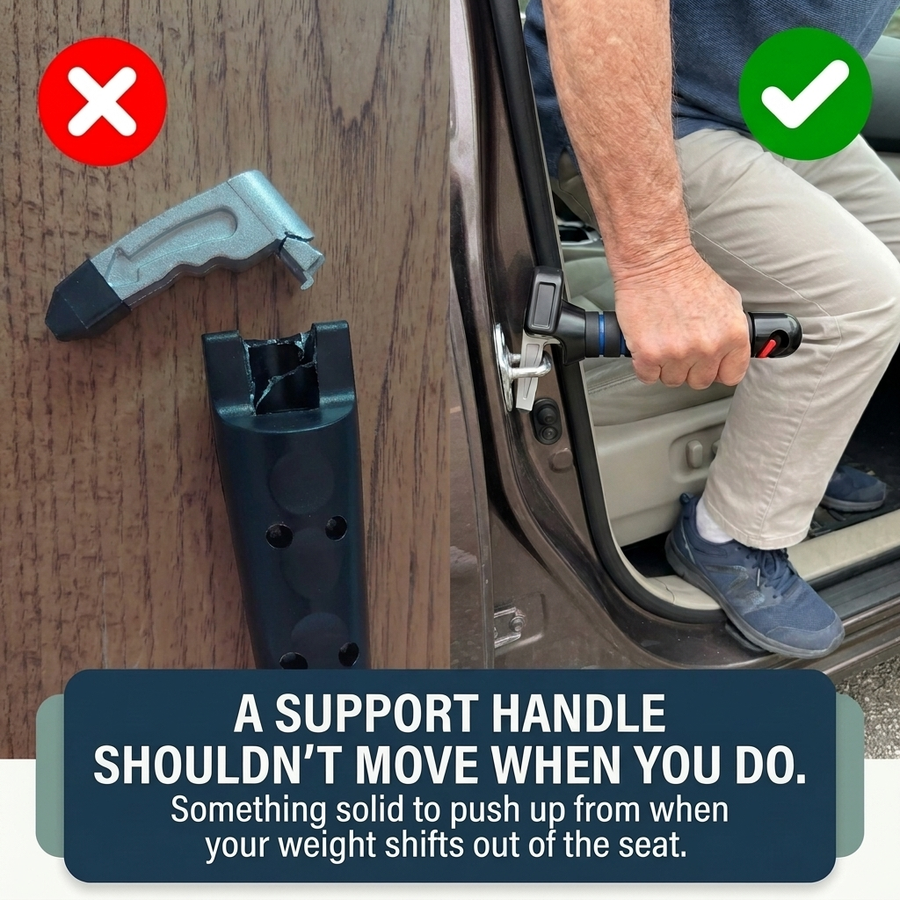
Built for their full weight.
Renva holds up to 400 lb. They don’t have to “go easy” on it, or keep one hand on you just in case.
It works on the passenger side.
If you’re driving, they’re getting out on the passenger side — the side with no steering wheel to hold on to. That door has the same U-shaped latch, so Renva works there too.
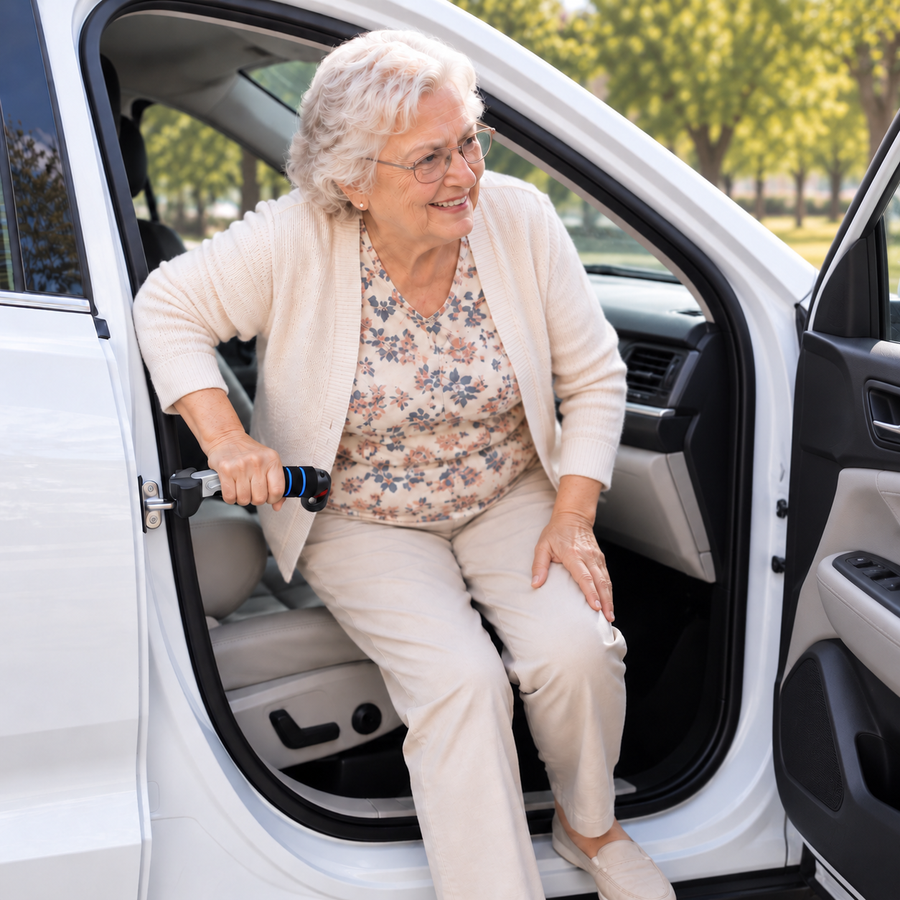
It grips the steel, not your paint.
Renva holds onto the steel striker — not the paint, not the door panel — so it won’t scratch or mark your car.
+ The little things that make it easy to live with:
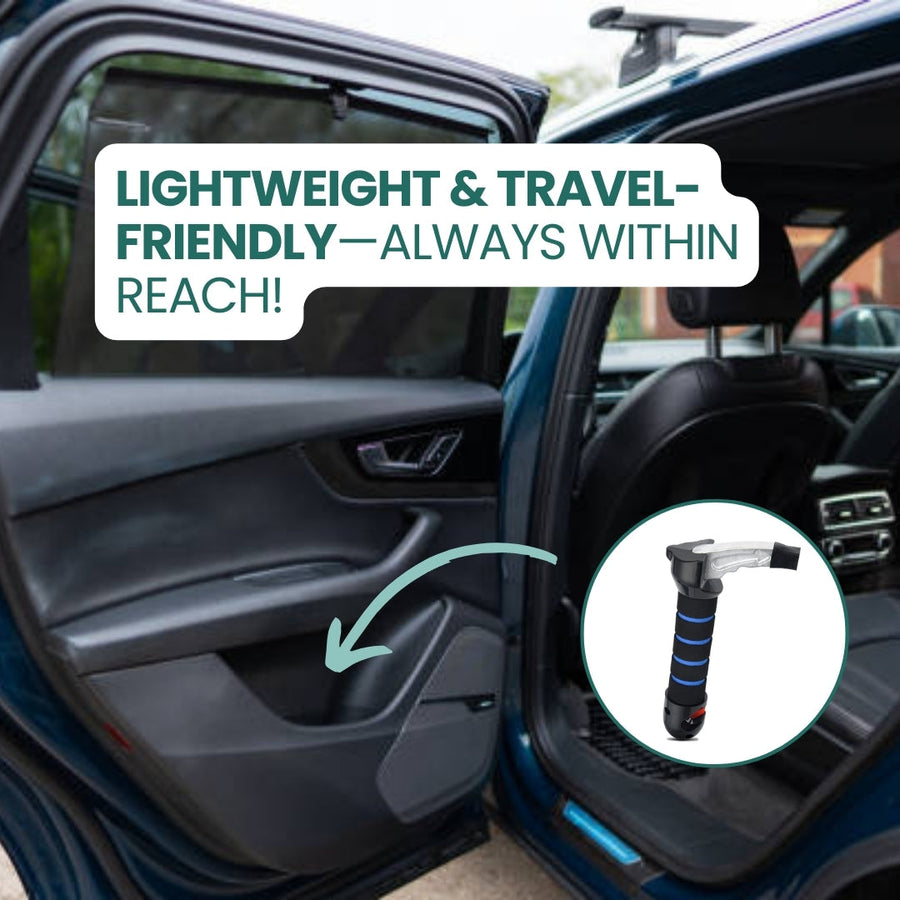
- Light enough for the door pocket or a handbag
- Moves between cars in seconds
- Nothing to charge, adjust or set up
- Simple enough to show them once in the driveway
Coming home after hip or knee surgery?

This is where the rule matters most. Hospital guides for car transfers after a hip replacement tell patients to use the car for support rather than their walking aid, not to hold the car door, and to “wait until you are stable to take your walking aid(s).”3, 4
Renva gives you a solid point on the car to push from, so you’re not relying on the door, the walker or someone pulling your arm.
Tip: get it before surgery day, so it’s already in the car when you’re discharged. And always follow your surgeon’s or physical therapist’s instructions for getting in and out of the car.
Families who’ve added a handle say the same thing
Latch handles aren’t new — and families who’ve put one in a parent’s car describe the change in almost the same words:
This makes the world of difference when my mother gets in and out of the car.
Retailer review of a latch-style car handleI bought this for my father-in-law who has Parkinsons. He said he does not know how he lived without it.
Retailer review of a latch-style car handleMy Mother (whom I drive daily) is now safer and feels more able because of it.
Retailer review of a latch-style car handleworks great. wish I had gotten it sooner
Retailer review of a latch-style car handleThe idea works. Renva’s job is making sure it works in your car — locked tight, easy for them to use, and backed by a 90-day money-back guarantee if it doesn’t fit, hold or help.
Check your car in 10 seconds
Most latch handles disappoint for one reason: people guess. Don’t guess. Check.
- Open the door your parent gets out of.
- Look at the door frame, level with the latch on the door.
- See a U-shaped metal loop? Renva fits.
Most sedans, SUVs and trucks have one, on both the driver’s and passenger side.
Not sure about yours? Email your make, model and year to teamrenva@gmail.com and the Renva team will confirm before you buy. And if it doesn’t fit when it arrives, send it back for a full refund. No grinding it down. No guessing.

An honest note: Renva is a handhold, not a leg-lift. If the hardest part is lifting their legs over a high door sill, no handle fixes that. If the hardest part is having nothing solid to push up from, that’s exactly what Renva is for.
Try Renva for 90 days. If it doesn’t fit, hold or help, get your money back.
If you’ve already bought a stool, a cushion or a handle that ended up in the garage, you shouldn’t have to gamble again.
So every Renva order comes with a 90-day money-back guarantee.
Put it through real life — every appointment, grocery run and family drive, on the driver’s side and the passenger side. See how it fits your car, how solid it holds when they lean their full weight on it, and how much easier they get out.
If it doesn’t fit, doesn’t hold, or just doesn’t make getting them out easier, get your money back. No complicated process.
You have 90 full days to decide.
The one tool worth gifting your parents
It’s a small gift. It takes 3 seconds to use. And it’s there for the hardest few seconds of every trip.
Renva is sold direct by the Renva team, on the official Renva website.
Here’s what to do next:
Tap the button below to go to the official Renva page.
Choose your bundle. Buy 2, Get 1 Free is the most popular: one for their car, one for yours, and one for whoever drives them next.
Check out securely with card, PayPal, Apple Pay or Google Pay. Orders ship within 24 hours, with free tracked delivery.
 1 HandleOne car. One less daily worry.
Most popular
1 HandleOne car. One less daily worry.
Most popular
 Buy 2, Get 1 FreeOne for you. One for someone you love. One free.
Best value
Buy 2, Get 1 FreeOne for you. One for someone you love. One free.
Best value
 Buy 3, Get 2 FreeCover every car. Two handles free.
Here’s to easier trips — and fewer parking-lot struggles.
The Renva Team
P.S. Think about every car your parents get out of in a normal month: theirs, yours, your brother’s, the one that takes them to appointments. A handle only helps in the car it’s in. That’s why Buy 3, Get 2 Free is the best value: five handles for the price of three, so there’s one waiting in every car. They also make a thoughtful gift for friends whose parents are starting to struggle, too.
Questions families ask
Does it replace their cane?
No. They do different jobs. Renva is for standing up out of the seat; the cane is for walking once they’re steady. Use Renva to stand, then hand them the cane.
Will it fit our car?
Renva fits the U-shaped steel latch (the striker) on most sedans, SUVs and trucks, on both the driver’s and passenger side. Compatibility varies by vehicle, so check yours first: open the door and look for the U-shaped metal loop on the frame. Not sure? Email your make, model and year to teamrenva@gmail.com and the team will confirm before you buy. If it doesn’t fit when it arrives, return it for a full refund.
Will it hold their full weight?
Yes. Renva locks onto the steel striker, the same part that holds your car door shut, and holds up to 400 lb.
Will it wobble when they lean on it?
No. It seats tight and stays locked as they shift their weight to stand. No jiggle, no spinning, no popping out mid-lift.
Will it damage our car?
No. Renva grips the steel latch, not the paint or the door panel, so it won’t scratch or mark your car.
We’ve tried handles before and they didn’t help. Why is this different?
Most “assist handles” people try are either the car’s own grab handle, which is there to steady you rather than lift a person, or a cheap latch handle that wobbled or didn’t fit. Renva gives them a fixed, solid handhold right where their hand lands, so they push up from something that doesn’t move.
Straight answer: if the problem is having nothing to push from, this fixes it. If the problem is lifting their legs over a high door sill, no handle solves that.
Is it easy for an older parent to use?
Yes. Nothing to learn, nothing to install. It slides into the latch in seconds, and they push up the same way they’d push off a chair arm. Show them once in the driveway and they’re set.
Can I use it myself, without anyone helping?
Yes. That’s the point: it gives you something solid to push up from, so you’re not relying on anyone’s arm. Slide it in, push up, lift it out.
Does it work on the passenger side?
Yes. The passenger door has the same latch, so Renva works on whichever side they’re getting out of.
How fast will it arrive?
Orders ship within 24 hours with free tracked delivery. Delivery usually takes 5–8 business days, and tracking is sent to you by email.
What if it’s not right for us?
You’re covered by the 90-day money-back guarantee. If it doesn’t fit, doesn’t hold, or just doesn’t help, email teamrenva@gmail.com for a full refund.
References
- U.S. National Highway Traffic Safety Administration, Federal Motor Vehicle Safety Standard No. 206, “Door locks and door retention components,” 49 CFR 571.206. Primary door latch systems must not separate under a load of 11,000 N (about 2,470 lb) in one direction and 9,000 N (about 2,020 lb) in the other.
- University Hospitals Plymouth NHS Trust, “Top tips to stand safely” (patient information leaflet).
- United Lincolnshire Hospitals NHS Trust, “Getting in and out of the car following a hip replacement” (patient information).
- Northwestern Medicine, “Car Transfers After a Hip Replacement” (patient education, therapy services).
This page is an advertisement for Renva, written by the Renva team. It is not a news article. Guidance is quoted from public patient information leaflets; the NHS and Northwestern Medicine do not endorse Renva. Quotes labeled as retailer reviews come from public customer reviews of latch-style car handles in general, not reviews of Renva. Images are for illustration. Renva is a mobility aid, not a medical device, and it is not intended to diagnose, treat, cure or prevent any condition. If you are recovering from surgery or managing a medical condition, follow your doctor’s or physical therapist’s instructions for getting in and out of a car. Renva requires a U-shaped door striker; check your vehicle before use. Individual experiences vary.